






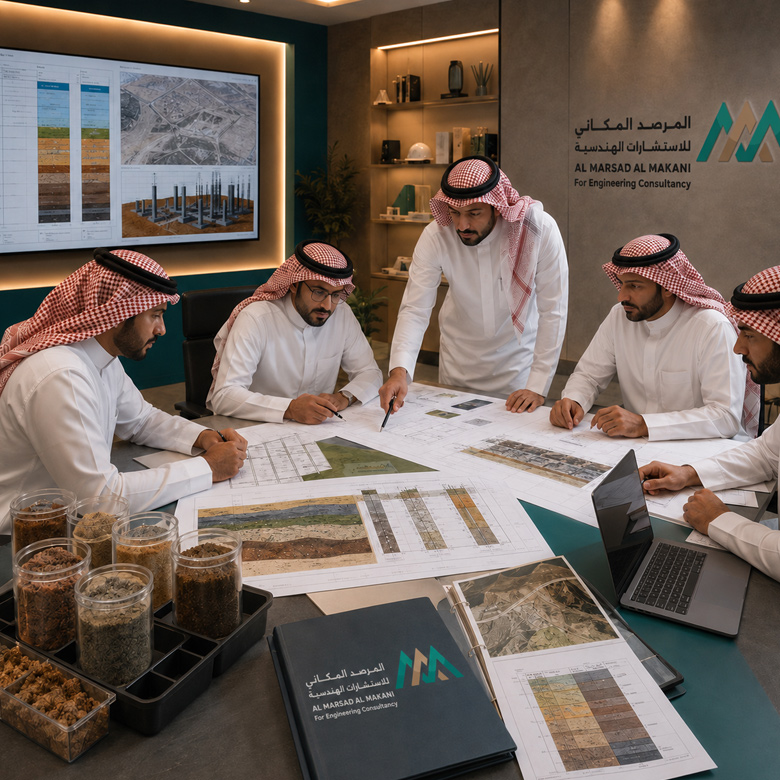
The Importance of Geotechnical Studies and Pre-Construction Soil Testing
Before starting any construction project, there is one essential question that must be answered accurately: Is the land suitable for construction?
The site may appear ready for development from the outside. The architectural concept may be clear, and the preliminary design may already be prepared. However, the safety of the project begins below the building, with the soil that will carry the structure throughout its operational life.
Geotechnical studies and soil testing are among the most important steps that precede design and construction. They reveal the nature of the ground, its bearing capacity, its layers, the groundwater level, settlement potential, and the risks that may affect foundations, excavation, or structural stability. Without this study, the structural design becomes based on assumptions that may not reflect the actual conditions of the site.
For this reason, geotechnical studies represent an essential element in protecting buildings, urban projects, and infrastructure works. They help the owner, developer, and consultant make more accurate technical decisions before entering the construction stage.
What Are Geotechnical Studies?
Geotechnical studies are a set of field, laboratory, and analytical works that aim to understand the properties of soil, rock, and groundwater within the project site. These works include drilling boreholes, collecting samples, carrying out field tests, conducting laboratory analyses, and then preparing a technical report that presents the test results and recommendations related to design and construction.
This study is not limited to identifying the soil type. It also helps understand how the ground behaves under loads, its suitability for the type of structure, the suitable foundation system, and any precautions that must be considered during excavation or construction.
Based on the results of the study, the structural engineer can design footings and foundations in a way that suits the site conditions instead of relying on general estimates.
Why Should Soil Be Tested Before Construction?
Soil testing before construction helps reduce risks that may appear after implementation. The soil may be weak, prone to settlement, contain unsuitable fill layers, be affected by groundwater, or require improvement before construction. If these issues are not identified early, they may lead to cracks, uneven settlement, construction difficulties, cost increases, or the need for corrective solutions after project completion.
An early study gives the project team a clearer picture of the ground and helps select the right solution from the beginning. It also helps avoid sudden changes in foundation type during construction, which can cause delays and additional costs.
The Relationship Between Soil and Structural Safety
Every building or structure transfers its loads to the soil through its foundations. If the soil cannot safely carry these loads, structural problems may appear in the short or long term.
Some of the most important problems related to poor understanding of soil conditions include:
Uneven building settlement.
Cracks in walls or floors.
Foundation exposure to groundwater effects.
Weak excavation stability during construction.
The need to modify the structural design after work has started.
Increased quantities of concrete or steel due to the absence of accurate data.
Therefore, soil studies do not only protect the foundations. They protect the entire project from decisions that may be costly or risky.
Boreholes and Their Role in Understanding Ground Layers
Boreholes are one of the most important steps in a geotechnical study. They involve drilling selected points within the site to reach different depths depending on the nature of the project, the height of the building, and the expected loads. Through boreholes, the soil layers, their thickness, variations, and the characteristics of each layer can be identified.
Boreholes help determine whether the soil is consistent across the entire site or varies from one area to another. Part of the land may be rocky, while another part may contain fill or weak soil. This difference is highly important for design, because foundation distribution must consider the nature of each area within the site.
The more properly distributed the borehole locations are, the more accurately the study can represent the site.
Field and Laboratory Tests
After soil samples are collected from the site, they are examined through field and laboratory tests. Field tests help evaluate the soil in its natural condition, while laboratory tests help define its properties in greater detail.
These tests usually include identifying soil type, density, moisture content, shear strength, compressibility, liquid and plastic limits, grain size distribution, and the percentage of salts or sulfates when required.
These results help determine soil bearing capacity, estimate settlement, choose the foundation type, and identify whether soil improvement or special design and construction precautions are required.
Soil Bearing Capacity
Soil bearing capacity is one of the most important results that the structural engineer looks for in a soil report. It expresses the ability of the ground to receive loads from the building without unsafe settlement or failure.
If the bearing capacity is good, shallow foundation solutions can be used in many cases. If it is weak, the project may require deep foundations, soil improvement, replacement of fill layers, or special structural solutions.
Accurately determining bearing capacity helps design foundations that are both safe and economical. Overdesign may increase cost, while underdesign may expose the project to risk.
Settlement and Its Risks to Buildings
Settlement is one of the most common problems in projects that are not based on accurate soil studies. Settlement occurs when the soil compresses under the loads of the structure. It may be acceptable if it remains within allowable limits, but it becomes dangerous when it is large or uneven between different parts of the building.
Uneven settlement may lead to cracks, tilting in some elements, problems with doors and windows, or damage to finishes and infrastructure connected to the building.
Geotechnical studies help estimate settlement potential before construction and provide recommendations to reduce it by selecting the suitable foundation type, improving the soil, or adjusting the design.
Groundwater and Its Impact on Construction
The presence of groundwater within the site may affect excavation, foundations, waterproofing, and concrete works. For this reason, it is important to identify the groundwater level during the geotechnical study, especially in projects with basements, tanks, deep foundations, or sites located near low-lying areas.
A high groundwater level may require dewatering solutions during construction, a suitable waterproofing system, or special precautions to protect concrete and reinforcement. It may also affect the stability of excavation sides, especially if the soil is loose or weak.
Knowing this information early helps plan construction more safely and reduces surprises on site.
Expansive and Collapsible Soils
Some types of soil change their properties when exposed to water. Expansive soils swell when wet and shrink when dry, which can cause movement in foundations or floors. Other soils may collapse when water reaches them, resulting in sudden settlement.
These soil types require special study because they are handled differently from ordinary soil. They may require solutions such as soil replacement, water control, improvement of foundation layers, use of suitable foundations, or protection of the site from water leakage.
Ignoring these conditions may lead to ongoing problems after the building is in operation, especially in floors, pavements, boundary walls, and lightweight buildings.
The Effect of Salts and Aggressive Materials in Soil
Some types of soil or groundwater may contain high levels of salts, sulfates, or other substances that can affect concrete and reinforcing steel over time. Laboratory analyses help identify how aggressive the soil or groundwater may be toward construction materials.
If the results show the presence of salts or sulfates at significant levels, the engineer can take suitable precautions such as selecting a special concrete type, improving waterproofing, protecting foundations, or applying design requirements that reduce long-term impact.
This point is especially important for projects that require a long operational life or are located in environments with difficult soil characteristics.
Deep Excavation and Excavation Side Stability
In projects that include basements, tanks, or deep foundations, excavation side stability becomes an important issue. Some soil types may not remain stable during excavation and may require temporary or permanent shoring, especially in sites close to existing buildings, roads, or utilities.
A geotechnical study helps identify the soil type, groundwater level, and degree of excavation stability. It then provides recommendations regarding shoring methods, excavation side slopes, or precautions required during construction.
These recommendations protect workers, the site, and neighboring buildings, while reducing the risk of collapse or impact on nearby structures.
Choosing the Foundation Type
Soil testing results help determine the most suitable foundation type for the project. Some projects can be built using shallow foundations such as isolated footings or raft foundations, while others may require piles or deep foundations due to weak soil or high loads.
The choice of foundation does not depend only on the building height. It also depends on soil conditions, load distribution, groundwater level, expected settlement, and the presence of strong layers at different depths.
Choosing the right foundation system achieves a balance between safety and cost, and reduces the possibility of changes during construction.
Soil Improvement Before Construction
In some cases, the soil may not be directly suitable for construction, but this does not necessarily mean that the site is unsuitable. Soil can sometimes be improved using suitable engineering solutions such as compaction, replacement, grouting, engineered fill layers, drainage improvement, or alternative foundation systems.
The geotechnical study determines whether the soil requires improvement, the suitable improvement method, the treatment depth, and the precautions required during construction.
This helps the developer make a clear decision: Should the soil be improved? Should the foundation system be changed? Does the design need adjustment? Is the expected cost suitable for the nature of the project?
The Role of Geotechnical Studies in Reducing Cost
Some may think that soil testing is an additional cost. In reality, it helps reduce the overall cost of the project in the long term. An accurate study prevents random decisions and helps design suitable foundations without overdesign or underdesign.
The absence of a study may lead to higher costs due to foundation modifications during construction, work stoppage, treatment of later settlement, or emergency solutions. Early study helps anticipate problems and include their solutions in the design and construction plan from the beginning.
Therefore, the cost of the study is usually much lower than the cost of treating a structural problem or making a major modification after construction has started.
The Importance of the Soil Report for the Structural Engineer
The soil report is a key reference for the structural engineer when designing foundations. It provides important data such as soil layers, bearing capacity, expected settlement, groundwater level, excavation recommendations, and the proposed foundation type.
Without a clear report, the designer is forced to use general assumptions that may not be suitable for the site. This may lead either to an unnecessarily expensive design or to a design that is not sufficient for the soil conditions.
A good soil report helps produce a more accurate design and makes coordination between the geotechnical and structural teams clearer.
The Importance of Soil Testing in Infrastructure Projects
Soil testing is not limited to buildings. It is also highly important in road projects, water and sewer networks, treatment plants, tanks, bridges, channels, and yards. All these projects interact directly with the ground.
In roads, soil studies help determine pavement layers, bearing capacity, and weak zones. In sewer and water networks, they help define excavation conditions, trench stability, and how to deal with groundwater. In tanks and heavy structures, they help design safe foundations and reduce settlement.
For this reason, geotechnical studies are an essential part of the quality of infrastructure projects and are not limited to buildings only.
Soil Testing in Mountainous Areas and Slopes
In mountainous areas or sites with slopes, knowing soil bearing capacity alone is not enough. It is also necessary to study slope stability, rock characteristics, joints and fractures, landslide potential, and the effect of excavation or cutting on site stability.
These cases require more detailed geological and geotechnical studies, and may require solutions such as retaining walls, slope stabilization, protection nets, or special drainage systems.
Neglecting these studies in sloped sites may create major risks for the project and surrounding areas.
When Does a Project Need a Geotechnical Study?
A project needs a geotechnical study before design or before issuing construction drawings, especially in the following cases:
Constructing a residential, commercial, or administrative building.
Developing a multi-story project or a project with high loads.
Implementing basements or deep excavation.
Working on a site near a valley or low-lying area.
The presence of groundwater or wet soil.
Implementing roads or infrastructure networks.
Building on filled land or land with unknown history.
Working in a mountainous or sloped site.
The presence of neighboring buildings that may be affected by excavation.
The need to obtain foundation design approval from a competent authority.
The earlier the study is carried out, the clearer the design and construction decisions become.
Common Mistakes When Dealing with Soil Testing
There are several mistakes that may reduce the value of a geotechnical study, including:
Carrying out too few boreholes that do not represent the entire site.
Choosing depths that do not suit the nature of the project.
Relying only on an old report for a nearby site.
Failing to link soil results with structural design.
Ignoring the groundwater level.
Not studying the effect of salts or aggressive materials.
Starting excavation before reviewing the recommendations.
Not updating the study when the design changes or loads increase.
Neglecting soil follow-up during construction if different layers appear.
Avoiding these mistakes helps achieve the real benefit of the study and gives the project a safer foundation.
The Role of the Consulting Firm in Geotechnical Studies
The consulting firm helps the owner and developer define the suitable scope of study for the project, select borehole locations, follow up on field works, analyze results, and prepare clear recommendations that can be used in design and construction.
It also helps connect the study results with the requirements of structural design, excavation, infrastructure, and on-site risk management. This integration is important because soil testing is not a separate report isolated from the project. It is part of the engineering decision-making system.
Having a technical team capable of reading soil conditions and linking them to the project helps reduce risks and improve the quality of outputs.
How Does Al Marsad Al Makani Support This Type of Study?
Al Marsad Al Makani provides engineering and spatial services that help understand the site before construction by integrating geotechnical studies, topographic surveying, site analysis, geological studies, and Geographic Information Systems. This integration helps create a clearer picture of the land and connect soil characteristics with the site, drawings, and design decisions.
These outputs help the owner, developer, and consultant make more accurate decisions regarding foundations, excavation, soil improvement, and site-related risk management before construction begins.
Geotechnical studies and soil testing are an essential step before construction because they reveal what cannot be seen on the surface of the site. Through these studies, it becomes possible to understand ground bearing capacity, estimate settlement, identify groundwater levels, choose the foundation type, and define the precautions required during excavation and construction.
A project that begins with an accurate soil study is safer, more organized, and less exposed to unexpected issues and costly modifications. Therefore, soil testing is not a formality. It is an engineering foundation that protects the project from the beginning and supports long-term construction quality.