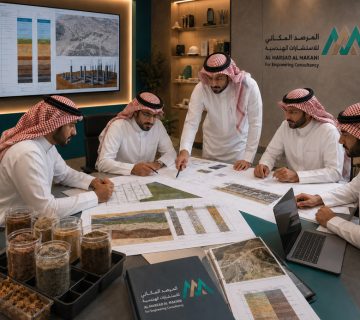







The Role of Engineering Studies in Project Success Prior to Execution
The success of any project does not begin when construction starts on site. It begins much earlier, at the stage of study, analysis, and understanding the nature of the land, the surrounding environment, and the project requirements. Every decision made before execution has a direct impact on project quality, cost, delivery time, safety level, and its ability to operate efficiently after completion.
Engineering studies provide project owners, developers, and consultants with a clearer understanding of the site before moving into design or construction stages. They help identify challenges early, define potential risks, and select suitable solutions instead of dealing with problems after they appear on site. For this reason, engineering studies have become an essential step in urban development projects, infrastructure projects, industrial sites, residential developments, roads, utilities, and projects located in areas with special geological or environmental conditions.
What Are Engineering Studies?
Engineering studies are a set of technical and analytical activities that aim to understand a project from multiple perspectives before construction begins. These studies may include site inspection, soil analysis, natural hazard assessment, utility network evaluation, traffic impact studies, stormwater and flood path analysis, environmental assessment, and topographic surveying.
Engineering studies are not limited to collecting data. They also involve analyzing this data and converting it into clear outputs that support decision-making. These outputs may include technical reports, maps, drawings, digital models, engineering recommendations, or results that help design and construction teams choose solutions that suit the nature of the project.
Why Do Successful Projects Start with Studies?
Starting construction without sufficient study is like making a major decision based on incomplete information. A site may appear suitable from the outside, but the real details become clear when studying the soil, levels, existing utilities, water paths, traffic movement, or geological risks. These factors can affect the design, construction method, project cost, or even the suitability of the site for certain uses.
When studies begin early, the project team has a better opportunity to adjust the design, choose suitable technical solutions, and avoid conflicts before they turn into costly issues during construction. Studies also provide clearer expectations for the owner, developer, and consultant, making the project more organized from the beginning.
Understanding the Site Before Design
Every site has its own characteristics. Some sites are located in low-lying areas that may be affected by water accumulation, while others have weak soil that requires special foundation solutions. Some sites may contain hidden underground utilities such as water lines, cables, or sewer networks, while others may be located near slopes or rock formations that require geological study.
Engineering studies help understand these characteristics instead of relying on assumptions. Through topographic surveying, soil testing, geophysical studies, hydrological studies, and geological studies, it becomes possible to build an accurate picture of the site before making design and construction decisions.
This early understanding reduces the possibility of sudden changes during construction and helps select solutions that are more suitable for the land and the project.
Reducing Risks Before They Appear
One of the most important benefits of engineering studies is that they help detect risks early. Risks discovered before construction can be managed at a lower cost and in less time, while risks that appear during construction may lead to work stoppage, design changes, increased costs, or schedule delays.
Examples of these risks include:
Unsuitable soil for structural loads.
Groundwater that may affect excavation or foundations.
Potential exposure to flooding or water accumulation.
Buried cables or pipelines within the work area.
Weak connectivity between the project and road or utility networks.
Nearby slopes, rocks, or natural hazards that may affect the site.
Addressing these points during the study stage gives the project a safer and clearer foundation.
The Role of Soil Testing in Protecting the Project
Soil testing is one of the most important studies carried out before construction projects. The soil is the foundation that supports the building or facility, and any lack of understanding of its properties can lead to major problems in the future.
Soil testing helps identify the bearing capacity of the ground, soil layers, groundwater level, settlement potential, and the suitable foundation type for the project. It also provides important data for structural engineers when designing foundations and load-bearing elements.
Having a clear soil report before design helps select an appropriate structural system, reduces the likelihood of changes during construction, and supports the long-term safety of the project.
The Importance of Topographic Surveying and Spatial Data
Topographic surveying provides an accurate picture of the site, including boundaries, levels, existing elements, roads, surrounding buildings, and slopes. This data helps planning and design teams work based on real information instead of relying on general estimates.
Geographic Information Systems (GIS) also help organize spatial data and convert it into analyzable layers. This makes it easier to understand the relationship between the project and the site, utilities, roads, surrounding environment, and potential risks. When spatial data is accurate, planning and design decisions become clearer and more reliable.
Hydrological Studies and Flood Risks
In many projects, surface water and flash floods are important factors that affect design and construction. A site located within a natural water flow path or water accumulation area requires careful study before development begins.
Hydrological studies help understand water paths, flow directions, surrounding catchments, accumulation zones, and the potential level of risk to the project. Based on these studies, it becomes possible to define drainage solutions, protect structures, improve stormwater networks, or adjust certain planning elements to suit the nature of the site.
These studies are especially important in road projects, residential developments, mountainous areas, valleys, and sites affected by seasonal rainfall or sudden flooding.
Traffic Studies Before Project Development
Any major urban, commercial, or residential project affects the surrounding traffic movement. Traffic studies help understand the project’s impact on roads, entrances, exits, parking areas, pedestrian movement, and expected trip generation.
Through these studies, it becomes possible to determine the need for additional access points, intersection improvements, parking organization, traffic flow adjustments, or solutions that reduce congestion. They also help connect the project with its urban surroundings more efficiently, improving the experience of users and visitors.
Detecting Buried Utilities Before Excavation
One of the major challenges that may appear during construction is the presence of buried utilities that are not accurately documented, such as water lines, sewer networks, electrical cables, telecommunications lines, or service chambers. Excavation without knowing these elements can damage networks, disrupt services, or create risks on site.
Technologies such as Ground Penetrating Radar (GPR) and geophysical surveying help detect buried elements before excavation begins. This step is important in road projects, infrastructure works, urban development, and existing sites that may contain old or unclear utility networks.
Supporting Design with Accurate Data
Good design does not depend only on aesthetic concepts or functional requirements. It also needs accurate data about the site. The architect needs to know the site boundaries and levels. The structural engineer needs soil data. The infrastructure engineer needs to understand networks and routes. The planner needs to understand movement, land uses, and the relationships between project elements.
When engineering studies are available from the beginning, the design becomes more realistic and conflicts between different disciplines are reduced. This helps produce drawings that are more practical and easier to execute.
Reducing Unexpected Costs
One of the most important benefits of engineering studies is that they help reduce unexpected expenses. A problem discovered during construction is usually more costly than a problem identified during the study stage.
For example, discovering weak soil during construction may require changing the foundation type or temporarily stopping work. Discovering buried utilities after excavation has started may require rerouting. Identifying a drainage problem after project completion may require costly corrective solutions.
Early studies help anticipate these challenges and include their solutions within the project plan from the beginning.
Improving Construction Quality
Engineering studies do not only serve the planning stage. They also affect the quality of construction. When the contractor, consultant, and supervision team have clear information, site execution becomes more organized. The reports and drawings produced from the studies also help guide on-site activities and reduce differences in interpretation between project parties.
Clear data reduces conflicts, improves coordination, and supports more accurate quality control.
Supporting Approval and Permitting Procedures
Many projects require technical reports and studies as part of approval or permitting requirements. These may include soil studies, traffic studies, environmental studies, hydrological studies, survey drawings, or technical reports related to the site.
Preparing these studies professionally helps facilitate project review by the relevant authorities and provides the project team with clear outputs that can be relied on throughout approval and development stages.
The Relationship Between Engineering Studies and Sustainability
Sustainability in projects is not only about using environmentally friendly materials. It begins with understanding the site and respecting its natural conditions. Choosing a suitable location, managing water, reducing risks, protecting soil, organizing movement, and improving infrastructure efficiency are all elements connected to engineering studies.
A good study helps develop a project that is more compatible with its surrounding environment, reduces waste in resources, time, and cost, and supports the creation of projects that can be operated and maintained efficiently over the long term.
When Does a Project Need an Engineering Study?
A project may need an engineering study at different stages, but the best time is before design or before construction begins. The importance of studies increases in the following cases:
When developing new land.
When constructing a residential, commercial, or industrial project.
When implementing an infrastructure or road project.
When the site is near a valley, slope, or watercourse.
When there is a possibility of buried utilities.
When approval or licensing from a competent authority is required.
When working on an existing or complex site.
When there are differences in levels or ground conditions.
The earlier the study begins, the greater the project’s ability to avoid unexpected issues.
How to Choose the Right Study for Your Project
Choosing the right study depends on the nature of the project and the site. Buildings usually require soil testing and topographic surveying, while road and infrastructure projects may require hydrological studies, utility detection, and traffic analysis. Mountainous or rocky sites may require geological studies and natural hazard assessments.
The best approach is to start with a comprehensive assessment of the project’s needs. The required studies can then be identified based on the site conditions, project stage, and the type of decision that needs to be supported.
The Role of Consulting Firms in the Pre-Construction Stage
Specialized consulting firms help clients read the project from a technical perspective and define the studies and deliverables required for the site. They also help organize priorities, choose the right tools for data collection, analyze the results, and provide practical recommendations.
Having a multidisciplinary consulting team adds significant value, because a project is not affected by one factor only. It is influenced by a group of connected factors such as land, water, movement, environment, design, infrastructure, and supervision.