





Integrated environmental study to complete licensing requirements and minimize the project’s environmental impacts in Wadi Naba – Al Jumum Governorate..
Environmental Impact Assessment (EIA) Study for Fahad Al Suwaihri Company Crusher
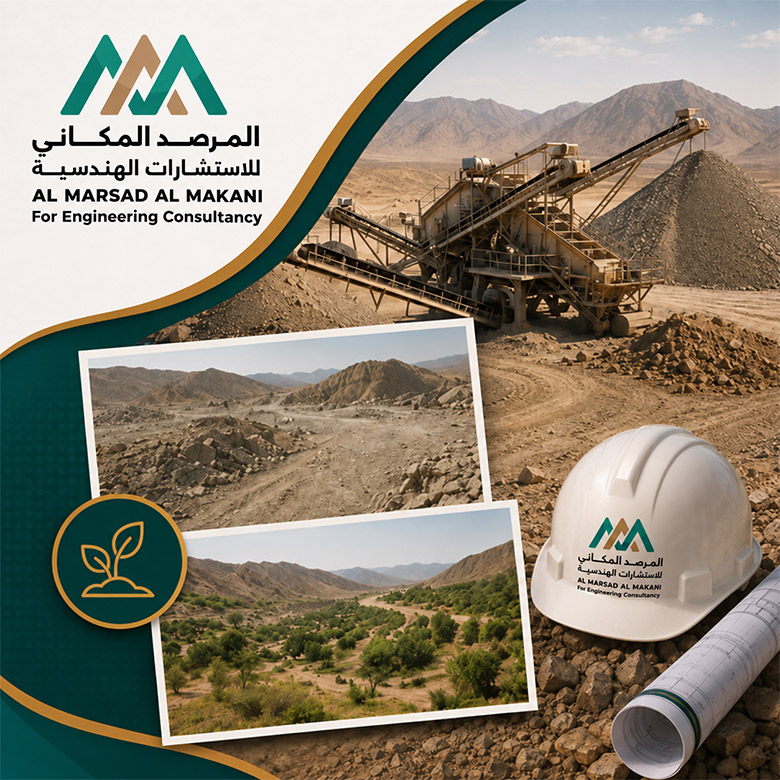
Al Marsad Al Makani conducted an Environmental Impact Assessment (EIA) study for Fahad Al Suwaihri Company’s crusher located in Wadi Naba, Al Jumum Governorate, Makkah Region, as part of the requirements for completing licensing procedures with the Ministry of Industry and Mineral Resources. The study focused on assessing the project’s potential environmental impacts and evaluating the existing environmental conditions of the site, including air quality, surface and groundwater, soil, noise and vibration, biodiversity, and land use. This provided a clear understanding of the relationship between crusher operations and the surrounding environment.
The scope of work included preparing a general description of the project and surrounding area, assessing potential environmental impacts, identifying environmental risks, developing mitigation and impact-reduction measures, preparing an Environmental and Social Management Plan (ESMP), and developing an environmental monitoring and surveillance plan. The study also included stakeholder engagement and the preparation of final conclusions and recommendations. These outputs supported the process of obtaining regulatory approvals and licenses, enhanced the project’s environmental performance, protected natural resources, and improved engagement with the local community, helping achieve a balance between operational requirements, environmental compliance, and sustainability.
- ClientFahad Al Suwaihri Company
- Project DescriptionAn Environmental Impact Assessment (EIA) study for a crusher located in Wadi Naba, Al Jumum Governorate, Makkah Region. The scope included assessment of existing environmental conditions, air quality and emissions, noise and vibration, surface and groundwater, soil and land use, waste management, occupational health and safety, and biodiversity. It also included the preparation of mitigation measures, an Environmental and Social Management Plan (ESMP), an environmental monitoring and surveillance plan, and the final report to support licensing requirements with the relevant authorities.